AI vs. Human Touch: The Future of Real Estate Photo Editing in 2026
The real estate industry is no stranger to disruption. From the rise of Zillow to 3D Matterport tours, technology has always driven the market forward. In 2026, the biggest conversation is no longer about the camera—it’s about Artificial Intelligence (AI).
As AI tools become more sophisticated, many realtors and photographers are asking: “Can AI do the editing for me? Or do I still need a professional editor?” The answer lies in the balance between automation and artistry.

1. How AI is Revolutionizing the Editing Workflow
AI has moved beyond simple filters. In 2026, professional editing houses use AI to handle the “heavy lifting” tasks that used to take hours:
-
Automated Culling: AI can now analyze 100 raw shots and instantly pick the sharpest, best-composed images.
-
Instant Object Removal: What used to take 20 minutes of “cloning” in Photoshop can now be done in seconds with generative fill AI.
-
Semantic Segmentation: AI understands what is a “window,” what is a “floor,” and what is “grass.” This allows for instant masking and color correction of specific elements without affecting the rest of the image.
2. The Limitations: Why AI Still Needs a Human Pilot
Despite the “magic” of AI, it still lacks two critical components of a successful real estate listing: Context and Consistency.
The Problem of “Hallucinations”
AI sometimes “invents” details that aren’t there. It might add a chair with five legs or create a window reflection that doesn’t match the street outside. In real estate, accuracy is legal. A professional editor ensures that the AI hasn’t accidentally altered the physical reality of the property.
Brand Consistency
Every top-tier real estate photographer has a “signature look”—perhaps a certain warmth to the wood tones or a specific clarity in the windows. AI often produces a “generic” look. A human editor fine-tunes the AI output to ensure it matches the photographer’s brand and the realtor’s expectations.
3. The “Human-in-the-Loop” Model: The Best of Both Worlds
In 2026, the most successful Real Estate Editing services use a “Human-in-the-Loop” approach. This means using AI for speed and humans for quality control.
-
Speed: AI handles the initial HDR blending and basic color correction.
-
Precision: A human editor reviews the image, fixes AI errors, and performs complex “Virtual Staging” that requires an eye for interior design.
-
Final Polish: The editor ensures that the vertical lines are perfect and the “Day-to-Dusk” sky looks natural, not radioactive.
4. AI and the Rise of “Smart” Virtual Staging
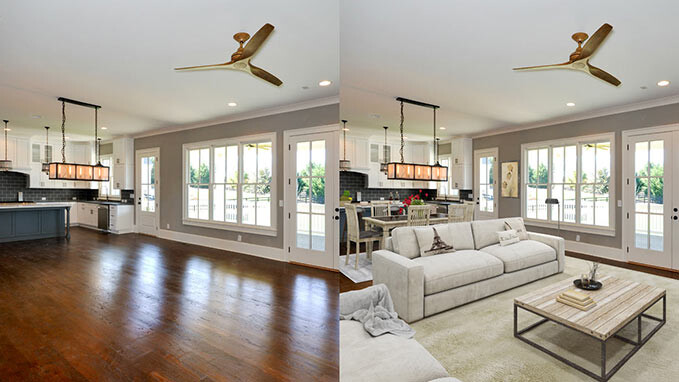
In 2026, AI-powered virtual staging allows editors to instantly “re-skin” a room.
-
Style Swapping: With one click, an editor can show a buyer what a living room looks like in Bohemian, Modern, or Industrial styles.
-
Empty-to-Lived-In: AI can realistically “clutter” a home with books, plants, and coffee cups to make it look authentic and lived-in, rather than a sterile showroom.
5. What This Means for Your Business
If you are a realtor or photographer, you shouldn’t fear AI; you should embrace the Hybrid Workflow.
-
Lower Costs: Because AI speeds up the process, editors can offer lower prices than they did five years ago.
-
Faster Turnaround: 12-hour delivery is now the industry standard, thanks to AI-assisted tools.
-
Higher Quality: With the “boring” parts of editing automated, human editors can spend more time on the artistic details that actually sell the home.
Comparison: AI-Only vs. Human-AI Hybrid
| Feature | AI-Only Apps | Human-AI Hybrid Service |
| Accuracy | 80% (Risk of glitches) | 100% (Manual Verification) |
| Object Removal | Hit or miss | Flawless |
| Emotional Impact | Flat / Generic | Optimized for Sales |
| Legal Compliance | High risk of over-editing | Safe for MLS standards |
Conclusion: The Editor is the Architect, AI is the Tool
In 2026, AI is like a high-speed power tool. In the hands of a novice, it can cause a mess. In the hands of a skilled Real Estate Editor, it creates masterpieces at lightning speed.
The future of real estate marketing isn’t about choosing between technology and humans—it’s about choosing a partner who knows how to use technology to highlight the humanity and beauty of a home.